• Skip to primary navigation
  • Skip to main content
Menu
  • Services
  • Model of Therapy
  • Job Opportunities
    • Paediatric OT
    • Mental Health OT
    • New Graduates
    • OT Student Placements
    • Allied Health Assistants
    • Client Support Roles
    • Job Opportunities Enquiry Form
EXPLORE & SOAR new Logo FC RGB 600px
Menu
  • News
    • Blog
    • Newsletters
  • About
  • Contact
    • Parent FAQs
    • NDIS FAQs
    • Career FAQs
    • General Enquiry Form
    • New Client Waitlist Enquiry

2026

What’s Really Behind Your Child’s Gross Motor Skills?

exploreandsoar · 1 June 2026 · Leave a Comment

What’s Really Behind Your Child’s Gross Motor Skills?

Let’s Begin at the Start

From the very beginning of life, your child is learning how to move. In the early months, this may look like curling into your chest, lifting their head during tummy time, pushing up through their arms, rolling from side to side, or reaching for a toy. As they grow, these early movements become crawling, sitting, pulling to stand, climbing, walking, running and jumping.

These are not just milestones – they are building their foundations of ‘Motor Patterns’ that support how to move in space, how much force to use, move both sides of the body together, and how to feel safe and steady in an organised, coordinated and confident way. All motor patterns stem from our reflexes, here’s the blog link to learn more.

This is why occupational therapists often look beyond whether a child can complete a skill and focus on how they move. A child may be able to run, climb or jump, but still use extra tension, speed, effort or avoidance to stay in the activity instead of moving with ease and control. Understanding these foundational movement patterns helps us identify what a child’s body may still be learning.

Flexion and Extension: Learning to Move the Body In and Out with Control

One of the earliest motor patterns children develop is flexion and extension. 

  • Flexion is the body’s ability to curl, bend and bring the body inwards. 
  • Extension is the ability to straighten, push, lift and move against gravity. 

These patterns begin during tummy time, rolling and floor play as babies learn to balance curling up, bringing their hands and feet into the middle of their body and stretching movements, lifting up their head, pushing arms up and away from the body. As children grow, this foundation supports sitting upright, climbing, running, jumping, landing and changing direction.

When flexion and extension are well developed, children move with more ease and control through the front and back of their body. Their body can activate when needed and relax afterwards. They may be able to sit, play, climb and move without constantly needing to adjust their body.

When this pattern is still developing, some children may use different strategies to help feel in control:

  • Hold tension through their neck, shoulders or body to stay upright
  • Move stiffly or brace themselves
  • Appear rigid in movements
  • Collapsed, slouch, lean on furniture or tire easily
  • Lying down often
  • Tiring quickly
  • Prefer to be inside to play than outside
  • Struggle to maintain attention and regulation because so much energy is used to stabilise the body

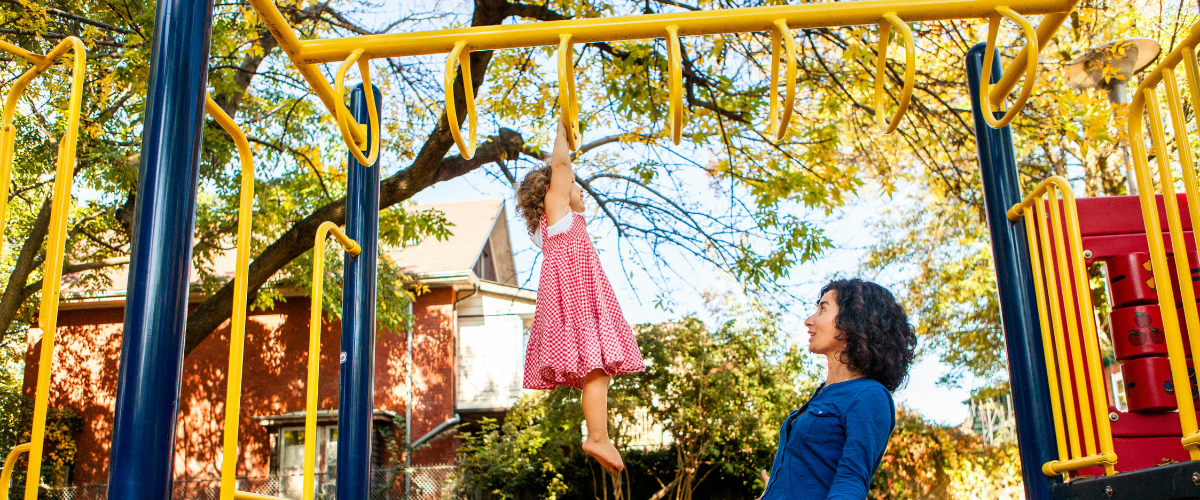
In occupational therapy, activities such as rolling, climbing, swinging, rough play, bouncing on exercise balls and crashing into mats are used in a tailored way. This helps children build body awareness and movement control in a playful fun way. 

The beauty of all of these activities is that they can also be done at home, in your backyard or at a park with a grassy hill and swings.

Top and Bottom: Learning to Stabilise for Movement together

Top and bottom motor patterns refer to how the upper body and lower body work together. Children need to develop stability through their hips, legs, trunk, shoulders and arms so that their body can move in an organised way.

This foundation supports:

  • Crawling and climbing
  • Jumping and balancing
  • Stepping over objects 
  • Walking on uneven surfaces
  • Moving safely through playgrounds
  • Standing at the sink to brush teeth
  • Balancing whilst putting pants on 
  • Climbing into the car
  • Sitting at a table for drawing or eating

When this pattern is working well, a child can keep their body steady while their arms or legs move. Their movement looks more controlled and organised.

When it is still developing, movement may look effortful or less coordinated. Children may:

  • Move their whole body as one piece
  • Arms or head collapses during movements or forget arms or legs when climbing – moving arms first or only legs. 
  • Seek crashing or movement to feel more organised
  • Avoid movement because it feels unpredictable
  • Use momentum to move through an activity and not activation of muscles.

OT sessions often target this pattern through obstacle courses, balancing on beams, climbing over, under or through equipment, crawling through tunnels and pushing balls, and stepping stone activities, moving through crash mats that combine movement with stability in a fun and meaningful way. 

What has been a fun obstacle course or activity that your children have loved? Was it made at home or somewhere in your community?

Left and Right: Building Coordination, Rhythm and Flow

The left and right motor pattern is how the two sides of the body work together. This includes using both sides of the body at the same time; alternating sides, crossing the middle of the body, using one side to stabilise while the other side completes a task and coordination movements smoothly.  

This pattern develops through crawling, walking, climbing and later supports:

  • Ball skills
  • Riding bikes or scooters
  • Playground games
  • Sport and dance
  • Motor planning and coordination

When left and right integration is well developed, movement looks rhythmic and automatic.

When this pattern is still developing, children may:

  • Rely heavily on one side of the body
  • Avoid crossing the middle
  • Swap hands during activities
  • Find ball skills or bike riding difficult
  • Struggle with coordination during play
  • Avoid playground equipment
  • Look more effortful and hard work to keep going 
  • They may know what they want to do, but their body may not yet know how to put the movement together smoothly

These challenges can also affect social participation when games feel too fast or unpredictable. This can become too overwhelming and have difficulty adjusting their body to the environment and others around them. 

In OT, activities such as crawling, animal walks, climbing, scooter boards, swings and throwing games help both sides of the body work together through timing and rhythmicity while building confidence and body awareness.

Why These Foundations Matters Beyond Gross Motor Skills

Motor patterns are important because they sit underneath so many of the skills families care about. They support:

  • Running, jumping and climbing
  • Handwriting and sitting posture
  • Dressing and toileting
  • Using cutlery and opening lunchboxes
  • Participating and joining in school, sport and family life

Movement foundations are also closely linked to emotional regulation. When a child’s body feels organised and stable movement can help them feel calm, alert and manage emotions. When movement feels unstable, effortful or unclear, the body has to work harder, children may appear avoidant, frustrated, silly or overwhelmed.

Reclaiming Potential with Clarity

When your child is bouncing on an exercise ball, crashing into mats, crawling through tunnels, swinging, climbing, rolling, balancing, pushing or pulling, they are not just playing. They are learning how to organise their body, use their muscles with control, understand where they are in space, coordinate both sides of their body, be more confident in movement and feel safe in their environment. By understanding motor patterns, we can look beneath the surface and see what a child’s body may still be learning. 

Check out some previous blogs that may give you ideas on what you can do in the community and different gross motor activities you can do at home that target your tummy neck and shoulder muscles.

Occupational therapy uses purposeful play to strengthen these foundational motor patterns so bigger skills can develop with more ease. By understanding what sits underneath movement, we can better support children exactly where they are in their development. If you have been wondering whether your child could benefit from this kind of support, we would love to have that conversation with you. Reach out to your treating clinician or touch base with us here or call 0477 708 217.

Until next time,
Maddie


If you’d like to chat more, please don’t hesitate to contact us today! Call us on 0477 708 217 or email admin@exploreandsoar.com.au


PUBLISHED JUNE 2026

Latest Posts

  • What’s Really Behind Your Child’s Gross Motor Skills?
  • The Juggle of Life: Getting Back to Basics
  • The Power of Relationships: Parent to Child Connection
  • It’s Not Just Emotions: Understanding Your Child’s Nervous System
  • Parent Coaching The Power in Collaborating, Empowering & Educating

The Juggle of Life: Getting Back to Basics

exploreandsoar · 1 May 2026 · Leave a Comment

The JUGGLE OF LIFE:
GETTING BACK TO BASICS

Every year around this time, life just seems to be a little busier, a little more chaotic – another appointment to juggle or follow up on, another school event or sporting activity – sometimes it feels like we tick one thing off the to-do list and add five more in its place. It’s the kind of busy that comes with parenting any number of children while also juggling some level of employment.

Why does it feel like families of children 0-14 years are so busy?

Facts: Did you know?

  • In June 2025, 44% of all Australian families had children or dependents aged between 0-14years.
  • Around 82% of families are classed as couple families, while 16% are classed as single parent families. 
  • Of all the couple families, 73% have both parents employed, with another 22% with one parent employed. 
  • The percentage of dual employed parents has risen over the last 20 years (2005-2025) by over 10%.
  • Single parent families also have a high rate of employment with 71% of single mothers and 81% of single fathers employed. 

(Labour Force Status of Families, June 2025)

For comparison, in June 1990, 49% of couple families were both employed (Labour Force Status and other Characteristics of Families, Australia, June 2000).  

No wonder parents or caregivers of children under the age of 14 are feeling so time poor and exhausted! This is such a drastic contrast compared to some of the experiences of our parents, yet we still aim to provide our children with similarities to our childhoods. We are generally trying to fit more ‘things’ into our lives now, more than ever before, without enough time in the day to do it all.

As parents, how can we support ourselves in ‘Reclaiming our Potential with Clarity’ in 2026?

How can we, as working parents or caregivers, get back to basics so we do not burn out or feel the parental guilt that we should be doing more? 

Work out what our non-negotiables are

What are your values? What are your boundaries? How can you try to protect and ensure that each day, week, month as the year goes on, you are keeping these non-negotiables at the forefront of your planning. 

Prioritise connection

As humans, we need connection of some form. It is hardwired into our brains. We need to feel a sense of belonging to a community – be it our immediate family, our friends, a community or sporting group. Prioritise how you can ensure you have connections sprinkled across your week.

Give yourself some grace; be flexible; be ok to say ‘no’.

Not every day or every week is going to be smooth sailing. There are going to be times where we need to be able to pivot because priorities change, life throws us a curve ball. We need to be ready, accept and be able to adapt in the moment. It doesn’t mean that you are failing because you were late to an appointment, or to soccer training. It doesn’t mean you do not care if you have to reschedule a coffee catch up with a friend. It just means in that moment, a different priority presented itself and needed to adapt. That could be an appointment for your child, or that your child is needing more connection and time with you and needs you to be present to watch their soccer training rather than dropping them off this week. Rearranging your schedule and adapting to what is the priority or non-negotatiable that day is ok. Saying “no, not at this moment” is a great skill to have, don’t be afraid to use it. A great piece of advice I have received is, “no is a complete sentence”. You do not have to justify yourself to anyone.

Check in with yourself and schedule in your own self care

As parents, we tend to let our needs become the bottom of the barrel so to speak – mums particularly are renowned for this. We see this every day within our families we support. But it comes back to instructions we hear from flight attendants on planes – you must put on your own oxygen mask first before assisting children or others. We need to make sure we are scheduling some time for our own self care – to fill our cup, to put on our oxygen mask; to ensure we can keep going! To ensure we can keep all the wheels turning as needed. It could be as simple as taking a bath, getting up a little earlier to enjoy a morning coffee before the household wakes, a quick 15 minute movement break or online Pilates video. Whatever it is that makes you feel good!

Check in on others too

If you are feeling it, you can probably guarantee someone else within your work or social or family circle is also feeling disconnected or busy. You may not have the time to catch up at length – but I encourage you to send the text to say just thinking of you or how are you, share the funny reel or crazy random photo that encapsulates your mood at that moment. It’s an opportunity for connection and to also say to another – “hey, I’m here, I’m walking alongside you also”.

And if you need some more ideas of ways to support yours and your family’s routine, please chat to our team. We may not have all the ideas or answers, but we might be able to help point you in another direction to find them. We are here for you, we see you and in this juggle of life with you!

Until next time,
Lori

References:

Australian Bureau of Statistics. (2025, June). Labour Force Status of Families. ABS. https://www.abs.gov.au/statistics/labour/employment-and-unemployment/labour-force-status-families/latest-release.

Australian Bureau of Statistics. (2000, June). Labour Force Status and other Characteristics of Families. ABS. https://www.abs.gov.au/ausstats/abs@.nsf/mf/6224.0


If you’d like to chat more, please don’t hesitate to contact us today! Call us on 0477 708 217 or email admin@exploreandsoar.com.au


PUBLISHED MAY 2026

Latest Posts

  • What’s Really Behind Your Child’s Gross Motor Skills?
  • The Juggle of Life: Getting Back to Basics
  • The Power of Relationships: Parent to Child Connection
  • It’s Not Just Emotions: Understanding Your Child’s Nervous System
  • Parent Coaching The Power in Collaborating, Empowering & Educating

The Power of Relationships: Parent to Child Connection

exploreandsoar · 26 March 2026 · Leave a Comment

The Power of Relationships:
Parent to Child Connection

You may have heard people say, “all Occupational Therapists do is play”— and they’re not wrong! Through play, we use our knowledge and skills to support children’s development in meaningful and engaging ways.

At Explore and Soar, one of our core values is Connections for Life. We prioritise strong relationships with our clients, families, and community, knowing that connection is central to achieving meaningful outcomes. The most powerful of these is the parent or caregiver–child relationship, and strengthening this bond is at the heart of what we do.

Our team is trained in the DIR/Floortime Model, developed by psychologist Stanley Greenspan. This relationship-based approach underpins our therapy and focuses on supporting each child’s development through connection, play, and individualised strategies.

What is DIR/Floortime?

DIR stands for Developmental, Individual Differences, and Relationships-Based. This model recognises each child’s unique developmental stage and personal profile, while using the parent–child relationship to support growth across key developmental areas.

In our sessions, therapists work alongside both the child and caregiver. We model strategies through play, provide opportunities for parents to practise them, and offer real-time coaching and feedback. This approach not only supports skill development but also builds confidence in applying these strategies at home — where it matters most.

Key Components of DIR

Developmental (D)

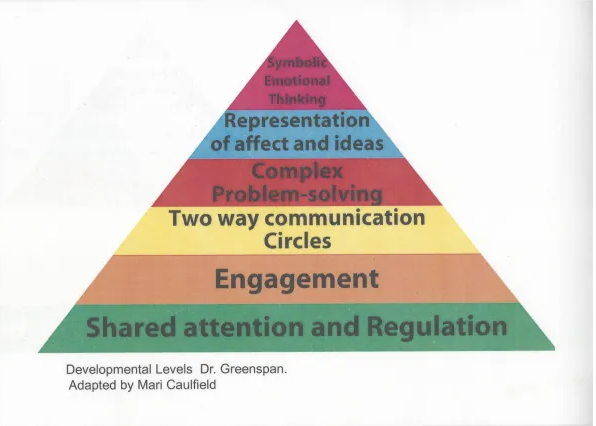
Children develop through a series of Functional Emotional Developmental Capacities, which build the foundation for social, emotional, and cognitive growth. These range from early regulation and engagement to complex thinking and reflective skills into adulthood.

There are nine (9) essential Developmental Capacities in building the foundation every child needs for optimal emotional-social growth and development. These nine levels outline vital developmental domains, even identifying the last three domains work from adolescence to adulthood. How amazing is that?!

  1. Regulation and interest in the world (0 – 3months)
  2. Engaging and relating – often referred to as ‘falling in love’, think cooing baby (2 – 5 months)
  3. Intentionality and two-way communication (2 – 10 months)
  4. Complex communication and shared problem solving (10 – 18months)
  5. Using symbols and creating emotional ideas (18 – 30 months)
  6. Logical thinking and building bridges between ideas (30 – 48 months)
  7. Multiple perspectives (4 – 7 years)
  8. Grey area thinking (6 – 10 years)
  9. Reflective thinking and internal standard of self (10 years to adulthood)

During our parent coaching sessions we often reference DIR/Floortime through this visual representation. We hope this looks familiar!

Individual Differences (I) 

Every child processes and responds to the world differently. This includes sensory processing, movement, communication, and problem-solving. Understanding these differences helps tailor therapy to each child—and can also support parents in reflecting on their own preferences and interactions.

Relationships-Based (R)

Strong, responsive relationships are essential for learning. Through connection, co-regulation, and shared interactions, children build the skills needed for development. Therapists support families to strengthen these interactions in everyday life.

Key DIR Strategies

Affect

Using facial expressions, tone of voice, and body language to engage a child emotionally supports connection, regulation, and learning.

Co-regulation

By tuning into and responding to a child’s emotional state, caregivers help them feel supported and regulated. This might mean matching their energy or gently guiding them back to a calm state.

Two-way Communication

Back-and-forth interactions — both verbal and non-verbal — help children understand the impact of their communication and build foundational social and language skills.

Using Floortime at Home

Floortime is a play-based approach that encourages connection, communication, and emotional development. Through playfulness, Floortime allows the fundamental connection in addressing and co-working on the DIR areas of development for each client. Some simple strategies include:

  • Set aside uninterrupted time (10–30 minutes) once a day with your child
  • Follow your child’s lead and join their play
  • Expand play by introducing emotions and new ideas
  • Turn actions into shared interactions
  • Be kind to yourself—this is a learning process for both you and your child

How Explore and Soar Can Help

We integrate DIR/Floortime principles into all our sessions, creating fun, engaging, and meaningful therapy experiences. We also prioritise parent coaching, empowering families to confidently apply these strategies at home.

If you’d like to learn more or incorporate these approaches into your sessions, we encourage you to speak with your therapist or contact our team.

As Stanley Greenspan said, “Let’s help our children become the poets of their inner lives.”

Until next time,
Sophie


If you’d like to chat more, please don’t hesitate to contact us today! Call us on 0477 708 217 or email admin@exploreandsoar.com.au


PUBLISHED APRIL 2026

Latest Posts

  • What’s Really Behind Your Child’s Gross Motor Skills?
  • The Juggle of Life: Getting Back to Basics
  • The Power of Relationships: Parent to Child Connection
  • It’s Not Just Emotions: Understanding Your Child’s Nervous System
  • Parent Coaching The Power in Collaborating, Empowering & Educating

It’s Not Just Emotions: Understanding Your Child’s Nervous System

exploreandsoar · 1 March 2026 · Leave a Comment

it’s not just emotions:
understanding your child’s nervous system

Is Emotional Regulation just about your emotions?

Emotional regulation is often described as something children can master through reminders, practice, or self-control. Parents are encouraged to help their child calm down, use their words, or manage big feelings. Yet for many families, this explanation doesn’t fully reflect what they see day to day.

You might notice your child copes well one day and struggles the next, or that a transition they managed yesterday suddenly feels overwhelming. School drop-off, after-school routines, or simply leaving the house can look entirely different depending on the day — even when nothing obvious has changed. That inconsistency can feel confusing, exhausting, and at times disheartening.

But what if emotional regulation isn’t just about emotions? What if it’s about a developing nervous system still learning how to navigate a busy, demanding world?

What is the body’s nervous system?

Each person’s body has their own nervous system. It is made up of the brain, spinal cord and nerves. The nervous system is the body’s command centre, shaping thoughts, emotions and actions. It makes everyday activities like walking, talking, swallowing, breathing, and learning possible and it also plays a vital role in how your body handles stress, helping you react quickly and appropriately to challenges. By processing information from your senses, the nervous system interprets what’s happening around you and directs how your body responds.

What is Polyvagal Theory?

Polyvagal Theory offers a helpful framework for understanding why children can cope well one day and struggle the next. It explains how the nervous system is constantly and automatically scanning the environment, relationships, and the body for cues of safety or threat — outside of conscious awareness. At a subconscious level, a child’s body is always asking, “am I safe enough right now?” to determine what to do next.

In the Polyvagal theory, safety and threat aren’t about actual danger. They’re about how the nervous system interprets what’s happening, based on sensory information from both outside and inside the body.

The nervous system takes in information through the senses — sight, sound, touch, and smell — as well as from within the body, including balance, body awareness, muscle activation, breathing, fatigue, hunger, and daily rhythms. When this input feels organised and manageable, the world is more likely to be experienced as safe. When it feels overwhelming, unpredictable, or difficult to process, the nervous system may register threat — even when nothing dangerous is happening.

What Are The Three Main States of the Nervous System?

Polyvagal Theory describes three main nervous system states that children move through across the day. These states are neither good nor bad. They are protective responses designed to help the body cope based on what it feels it needs. 

The Ventral State

The Ventral System is activated when a child’s nervous system feels safe enough. This state supports connection, learning and emotional flexibility and children can often engage with others, communicate, play and cope with everyday challenges. Emotions still come and go, but they are more manageable. 

A child might feel frustrated or disappointed, but they can recover with support. This is often the version of your child you recognise most easily; curious, warm, playful and capable.

  •  At home:  they may enjoy play, conversation and connection.
  • At school: this may look like a child who can participate in group time, follow routines, engage in learning or accept help.  
  • In the community: they are more able to tolerate change and differing sensory inputs. 

The Sympathetic State

The Sympathetic system is activated when the child’s nervous system starts to feel overwhelmed. This is the state of mobilisation, protection, agitation or feeling frantic. The body prepares for action to find an internal sense of safety, such as the need to escape, defend or regain control. This is not a child choosing to misbehave, it is the nervous system responding to a load that it cannot currently cope with. A child may appear anxious, restless, angry, or explosive. You might see meltdowns, yelling, hitting, running away, refusing tasks or constant movement. 

  • At home: this may also show up during everyday routines that place multiple demands on the body at once. For example, a child may become dysregulated during the evening routine, resisting getting dressed, shouting during dinner, or becoming upset over small requests.
  • At school: this can look like difficulty sitting still, emotional outbursts, struggling with transitions or difficulty engaging with peers. 
  • In the community: this can occur in situations that require constant scanning and adjustment. A child may become anxious or reactive when entering a birthday party, sports game, or busy cafe, especially when there is loud noise, unpredictable movement, and social expectations. 

The Dorsal State 

The Dorsal State is activated when a child’s nervous system is overwhelmed. This is the state of shutdown or collapse. When stress feels too much and escape doesn’t feel possible, the nervous system slows everything down to protect itself. A child may withdraw, go quiet, zone out, avoid interaction or appear flat and exhausted. 

  • At home: they may collapse after school, retreat to their room or struggle to engage or communicate. 
  • At school: they may sit quietly, not ask for help and slip under the radar. 
  • In the community: they may avoid participation altogether, seeking close contact with a parent or avoid interacting with others. 

This response is often misunderstood as a lack of motivation or disinterest, when in fact it is a nervous system trying to cope.

Why is there no predictability with my child’s emotions and ability to cope everyday?

One of the hardest things for parents is how quickly and unpredictably children can shift between states. A child may cope well in one environment but struggle in another because the nervous system responds to the total load it’s carrying — not just what’s happening in the moment. Sleep, sensory input, social demands, emotional stress, fatigue, hunger, excitement, and change all build up across the day.

Sensory processing and motor development play a significant role. For children who find it difficult to organise sensory input or who have delays in postural control and movement, everyday tasks can require far more effort. Sitting upright, filtering background noise, coordinating movement, or simply feeling grounded in their body can be exhausting. When the body doesn’t feel steady, the nervous system reaches overload more quickly and takes longer to return to a calm, connected state.

Viewed through this lens, behaviour begins to make different sense. Instead of asking, “why is my child doing this?” we might ask, “what state is their nervous system in — and what does their body need right now?”

How does Explore and Soar help through Polyvagal Theory?

We use this framework to support children and families at a foundational level, looking beyond behaviour to understand nervous system states, sensory processing, and motor development. In therapy, we prioritise safety, connection, movement, and sensory support before expecting engagement or skill use.

We also ensure parents, teachers, and educators are supported to understand what they’re seeing at home, school, and in the community. Through shared understanding, training, and practical strategies embedded across everyday environments, regulation becomes more predictable and less confusing for both the child and their supports.

When emotional regulation is viewed through a nervous system lens, behaviour tells a different story — a body still learning, a nervous system doing its best to manage the world. By meeting children at this level, meaningful change can unfold. Rather than pushing harder, we respond to what their nervous system has been asking for all along.

We love being able to foster and support this change with our children and parents. If this resonates with you, chat to your treating clinician in your next therapy session or enquire to learn more from us today or call 0477 708 217.

Until next time,
Maddie


If you’d like to chat more, please don’t hesitate to contact us today! Call us on 0477 708 217 or email admin@exploreandsoar.com.au


PUBLISHED MARCH 2026

Latest Posts

  • What’s Really Behind Your Child’s Gross Motor Skills?
  • The Juggle of Life: Getting Back to Basics
  • The Power of Relationships: Parent to Child Connection
  • It’s Not Just Emotions: Understanding Your Child’s Nervous System
  • Parent Coaching The Power in Collaborating, Empowering & Educating

Subscribe to our newsletter

Receive our news and updates via email. That's all.

View our Terms of Use.

Your feedback is always valued at Explore & Soar. If you have some feedback to help us support your needs better, please click here and share your valued feedback with us today.

STAY CONNECTED

  • mobile
  • mail
  • facebook
  • instagram

Explore and Soar

Explore and Soar © 2026 · Site by Design et Cetera

Explore and SoarLogo Header Menu
  • Home
  • Services
  • Model of Therapy
  • Job Opportunities
    • Paediatric OT
    • Mental Health OT
    • New Graduates
    • OT Student Placements
    • Allied Health Assistants
    • Client Support Roles
    • Job Opportunities Enquiry Form
  • News
    • Blog
    • Newsletters
  • About
  • Contact
    • General Enquiry Form
    • New Client Waitlist Enquiry
    • Parent FAQs
    • NDIS FAQs
    • Career FAQs