
• Skip to primary navigation
  • Skip to main content
Menu
  • Services
  • Model of Therapy
  • Job Opportunities
    • Paediatric OT
    • Mental Health OT
    • New Graduates
    • OT Student Placements
    • Allied Health Assistants
    • Client Support Roles
    • Job Opportunities Enquiry Form
EXPLORE & SOAR new Logo FC RGB 600px
Menu
  • News
    • Blog
    • Newsletters
  • About
  • Contact
    • Parent FAQs
    • NDIS FAQs
    • Career FAQs
    • General Enquiry Form
    • New Client Waitlist Enquiry

Emotional Regulation

Embracing Transitions and Growth: A Year of Learning and Achievement

exploreandsoar · 4 December 2024 ·

EMBRACING TRANSITIONS AND GROWTH:
A YEAR OF LEARNING AND ACHIEVEMENT

Embracing Transitions and Growth Fuels Our Success!

As we approach the end of the year, it’s the perfect time to reflect on the incredible journey we’ve shared. All I can say is, “What a year it has been!”

It was a year of exploring ways that we transition throughout our lives. From significant life changes such as transitioning into adulthood, moving homes, transitioning into a new school year (especially Kindergarten or year 7), starting new careers, trying a new sport, or managing health conditions to the everyday transitions we experience, like transitioning from home to school, catching the bus, transitioning from playtime to dinner, or switching off technology devices. The list is endless.

Every transition, big or small, contributes to our growth and learning.

By embracing transitions and growth, we develop new skills and gain valuable experiences at each stage of life.

Celebrating Success in Life Transitions

At Explore and Soar, we understand that embracing transitions is essential for both children and their families. Each step forward is a sign of progress.

What truly stands out this year is the unwavering support from parents and caregivers. Your dedication, love, and hard work in helping your children navigate these transitions have been truly inspiring. The effort, persistence, and love you pour into supporting your children as they reach their goals is a beautiful sight. We’ve witnessed the joy and pride on their faces as they master new skills – a testament to your hard work. We also recognise the challenges you face, and in those tough moments, please remember – we see you, we hear you, and we are here to help!

For more on managing life transitions, check out our previous blog to learn more about transitions in therapy.

Explore and Soar: Growing Together

This year, Explore and Soar has expanded its horizons! We introduced a fresh new look and broadened our age range to better support clients transitioning from school to university, work, or community life. We were also thrilled to open our new space in the Kurri Kurri clinic for therapy sessions when home or community settings aren’t ideal.

These transitions wouldn’t have been possible without the collaboration and commitment of our families and, most importantly, the continuous work of our dedicated team, who tirelessly support these transitions and consistently assist our families in new and evolving ways.

End-of-Year Celebrations & Transition Ahead

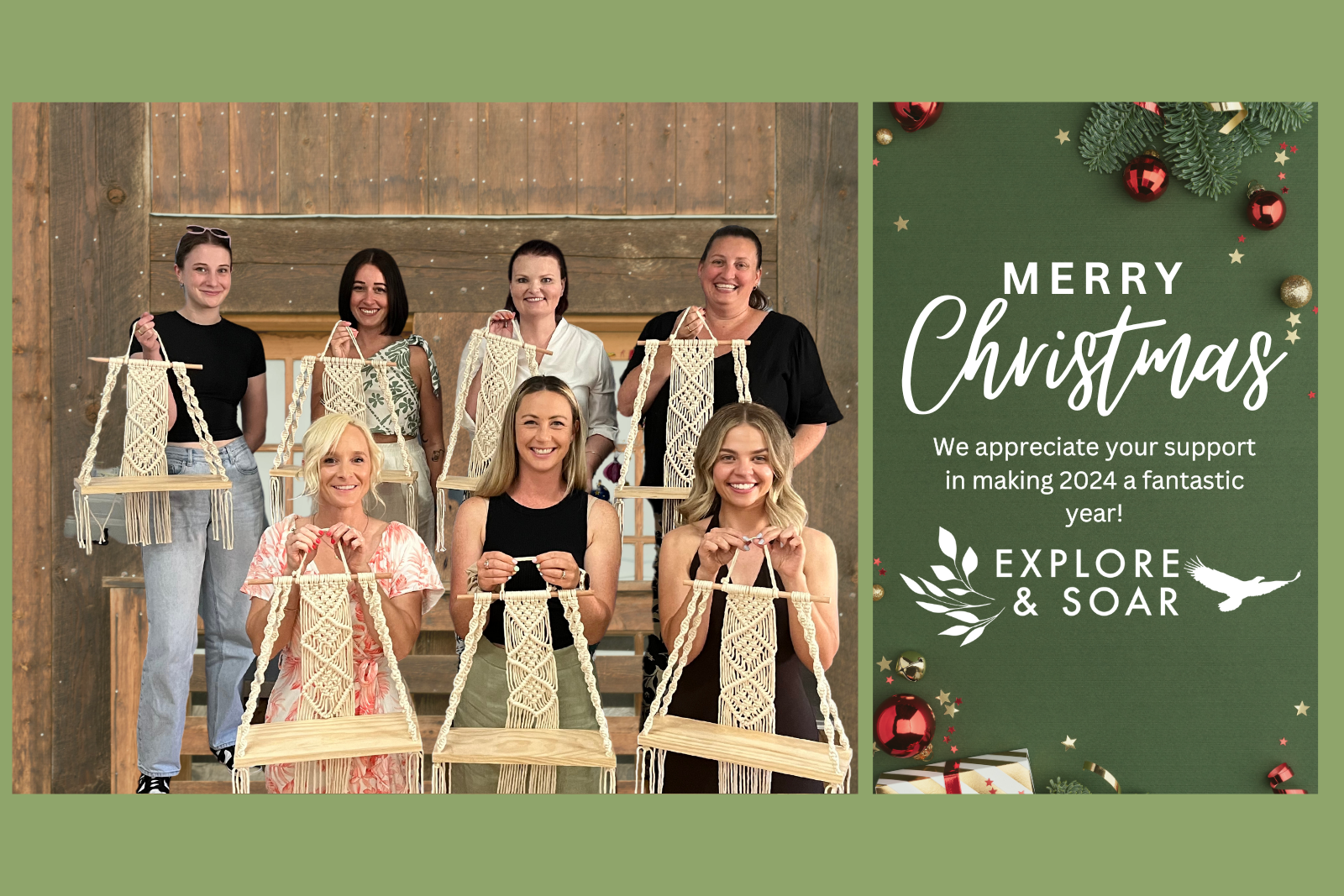
As we wrap up the year, the Explore and Soar team celebrated with a joyful Christmas party, creating beautiful macrame pieces and enjoying a delicious dinner. We had so much fun!

We also held our Annual Reflections and Projections Day, where we identified our achievements and worked toward an actionable plan for the new year. It was a wonderful opportunity to connect, share ideas, and commit to growing together as a team while continuing to support each other, our families, and our communities.

Important Dates: Holiday Closure & Upcoming January School Holiday Programs

At the end of each year, our team takes a well-deserved break to rest, recharge, and spend quality time with our families and friends!

This year, our Christmas closure will begin at the end of business on Friday, December 20th. We will return with our January School Holiday group programs starting Monday, January 13th, 2025!

If you’d like to join our January programs, be sure to secure your spot today! These fun and engaging programs will run from January 13th to 17th and again from January 20th to 24th, 2025. We cannot wait to see you there. Click here to see more about the programs and secure your spot!

Looking ahead to the new year, embracing transitions and growth will remain a central focus at Explore and Soar.

Until next time, we wish all of our Explore and Soar family a joyful Christmas break filled with quality time with loved ones, sunshine, and relaxation. Look after yourselves, and we can’t wait to reconnect in the New Year and continue this journey together!

Wishing You a Merry Christmas and a Happy New Year!

Until next time, 
Jess and the Explore and Soar Team

PUBLISHED DECEMBER 2024

Latest Posts

  • It’s Not Just Emotions: Understanding Your Child’s Nervous System
  • Parent Coaching The Power in Collaborating, Empowering & Educating
  • Reclaiming Potential with Clarity
  • A Year of Community for Wellbeing and End of Year Celebrations
  • School Readiness Transitioning to Kindergarten

Smooth Sailing Through Life’s Changes: Mastering Emotional Regulation During Transitions

exploreandsoar · 6 March 2024 · Leave a Comment

SMOOTH SAILING THROUGH LIFE’S CHANGES: MASTERING EMOTIONAL REGULATION DURING TRANSITIONS

As we delve deeper into 2024, emotional regulation is a prominent theme that goes hand in hand with supporting transitions.

Understanding Transitions

Transitions in life are inevitable. Whether it’s starting a new school year, moving to a new home, or experiencing changes within the family dynamic, transitions can be challenging for both parents and children alike. During these times of change, emotions can run high, leading to stress and uncertainty.

What is Emotional Regulation?

Emotional regulation refers to an individual’s ability to recognise, process and act upon the emotions that they feel within different situations on a regular day. It is one’s ability to adjust and control their energy level, emotions, behaviours, and attention to allow for success in connecting with our loved ones and engaging in our daily lives. We provide even more information on our “Tools to Support Emotions” blog.

Emotional regulation is a skill that is developed over time. Emotional regulation is essential for healthy emotional development and well-being throughout life. There are two stages to emotional regulation.

Co-regulation is the foundation for emotional development, allowing children to explore, learn and understand unfamiliar situations while parents support them by providing a safety net. 

Self-regulation involves the ability to notice and change/control one’s own feelings and adapt to surroundings. Emotional regulation is essential for healthy emotional development and well-being throughout life. To find out more information, refer to our “Emotional Regulation” blog.

The Emotional Rollercoaster

Transitions can evoke a range of emotions, from excitement and anticipation to anxiety and fear. Children who thrive on routine and stability may feel their sense of security disrupted, leading to vulnerability and insecurity. Similarly, parents may experience a mix of pride, worry, and doubt as they navigate unfamiliar territory. With the right tools and support, families can navigate transitions more smoothly, fostering emotional regulation and resilience along the way.

Strategies for Emotional Regulation

So, how can we help you support your child emotionally regulate during transitions? As Occupational Therapists, our role is to enable children and parents to recognise, understand and manage their emotions during times of change. Whether they are transitioning from breakfast to getting dressed or from home to school, navigating our emotions is a difficult task and can depend heavily on our sense of safety within ourselves and others and our connection to place, person, or thing. 

Here are some practical strategies and tools:

1. Transition Time: Allow ample time for transitions, providing a buffer for individuals to adjust mentally and emotionally.

2. Observation: Pay attention to the child’s body language, affect, tone of voice, and overall demeanour to gauge their emotional state.

  • Are we slouching our shoulders or dropping our head?
  • Are we smiling, and are our faces lit up? 
  • Is our tone of voice low, high-pitched, or fast-paced? 
  • Do we appear frazzled or disinterested?
  • Do we seem tired or overwhelmed from something that happened earlier?

3. Tools and Techniques we utilise, and you can too.

  • Visual schedules for predictability and routine. This also provides a point of orientation. 
  • Visual timers to set task timeframes and provide visual information of how long the task is.
  • Therapressure brushing is a technique for grounding and calming.
  • Therapeutic use of self for connection, following their lead and co-regulation.
  • Breathing exercises such as belly breathing or blowing bubbles.
  • Incorporating vestibular input through activities like wobble boards.
  • Providing oral input with stretches, cold drinks, or chewy foods.

Setting the Body Up

We call this process ‘Setting the Body Up’ as this prepares the body with sensory input and transition time to ease into daily activities.

Once our body is adequately ‘set up’ and we’ve allowed ‘transition time’. Transitions into daily activities won’t be as overwhelming. 

Emotional Continuum

We use cognitive-emotional strategies to support the emotional continuum. Strategies like sensory processing and cognitive strategies can help refine knowledge and apply skills in social situations. To learn more about how we use the above techniques as well as “Zones of Regulation,” “Size of Problem vs Reaction,” “The Alert Program,” “The Incredible Flexible You Series,” and “The Social Thinking Detectives” refer to our “The Emotional Continuum” blog. 

Embracing Change Together

Transitions are unpredictable, and allowing yourself grace in navigating them is essential. Understanding your own triggers and emotions is key to understanding how to emotionally regulate yourself. As parents, showing vulnerability can help model to our children that, YES, change can be scary, but you can do this as a TEAM.  Encourage open communication about challenges and solutions, empowering your child to take ownership and responsibility for the transition process.

Ask your child and yourself what is challenging about the transition to school/work or what makes it hard to go to soccer training or out for a catch-up with a friend in the afternoon, and what could we do to make it easier? This collaboration provides a sense of ownership and responsibility for our child and can result in increased adherence to routine, reducing the risk of emotional dysregulation.

Ready to embark on a smoother journey through life’s transitions? Start implementing these strategies today to foster emotional regulation and resilience in your family. Remember, every small step counts towards a smoother sail!

By implementing these strategies and fostering a supportive environment, families can navigate transitions more smoothly, fostering emotional regulation and resilience along the way. Contact us today if you would like to chat about transitions and how we can help.

If you’d like to chat more, please don’t hesitate to contact us today! Call us on 0477 708 217 or email admin@exploreandsoar.com.au

Until Next Time,
Molly

PUBLISHED MARCH 2024

Latest Posts

  • It’s Not Just Emotions: Understanding Your Child’s Nervous System
  • Parent Coaching The Power in Collaborating, Empowering & Educating
  • Reclaiming Potential with Clarity
  • A Year of Community for Wellbeing and End of Year Celebrations
  • School Readiness Transitioning to Kindergarten

Navigating the Transition to High School: A Parent’s Guide

exploreandsoar · 17 January 2024 · Leave a Comment

NAVIGATING THE TRANSITION TO HIGH SCHOOL: A PARENT’S GUIDE

Over the past few weeks, we have visited many of our local schools to talk to parents and families of children starting kindergarten in 2024. During these talks, we provide lots of information about how you can support your little person for a successful transition to big school. You can click here to read more about the transition to kindergarten.

We understand that your child’s journey through the educational system is filled with milestones and transitions from the very beginning; however, the preschool to kindergarten transition isn’t the only transition in our schooling lives. One of the next big milestones is transitioning from primary school to high school. 

This move can be filled with just as many emotions and feelings – excitement for finishing primary school, growing up and what lies ahead. It can also be anxiety-provoking at the thought of changing schools, changing routines and the challenge of friendship groups changing and needing to make new friendships. All of which are valid feelings and thoughts!

In this blog, we’ll explore the various challenges your child may encounter during this transition and provide practical strategies to support them as they step into high school life.

Some of the challenges your child may face could include:

  • New Friendships – Making new friends or friendship groups changing; having to be vulnerable in talking to other people we don’t know or feel comfortable around just yet.
  • New Routines – High school bell times may be slightly earlier or later; how will this impact upon the daily routines of your child?
  • New Environment – Navigating their way around a new school can be overwhelming, knowing where the toilets are, where to go for help, or where their next class is. Or even navigating their way to and from school.
  • New Rules and Expectations – Having multiple subjects with different teachers in a new school can be daunting, being unsure of what the expectations are in and out of the classroom.

So, how can we best support our children in this transition to high school?

  • Get to know the school: Talk about it; arrange additional transition days to allow your child to feel more comfortable in this new space if needed.
  • Practice any new routines:  Practice ways to get to and from high school; make sure your child knows which bus to catch or where they will be dropped off or picked up from.
  • Visual Aids: Create a visual schedule or simple checklist to determine what they must take each day. Timetables can be tricky to work out! Break it down into what they need each day and then for each subject.
  • Map out the school: Get a copy of the school map if possible and colour code important areas such as the library, toilets, canteen, office etc.
  • Prepare for Social Interaction: Create “cheat cards” for conversation starters and role-play how to introduce themself to others. Remind them that it is highly likely that other children in the group are just as nervous about making new friends as they are.
  • Time Management and Assignments: Help them schedule, plan and prioritise how to complete assignments. Keep in communication with their teachers to know when things are due and how you can support your child.
  • Advocacy: Advocate and encourage your child to advocate also for their needs! A new school means new teachers who don’t know your child’s cues or needs. Provide as much information as possible to support consistency for your child across their teachers.

As your child embarks on this exciting journey to high school, remember that you are not alone. We are here to support you. If you would like more information about our group program, click here to check out the flyer. You can also reach out to us on 0477 708 217  or admin@exploreandsoar.com.au. 

We would love to see you in our groups!

Until next time, 
Lori

ORIGINALLY PUBLISHED OCTOBER 31, 2023

Latest Posts

  • It’s Not Just Emotions: Understanding Your Child’s Nervous System
  • Parent Coaching The Power in Collaborating, Empowering & Educating
  • Reclaiming Potential with Clarity
  • A Year of Community for Wellbeing and End of Year Celebrations
  • School Readiness Transitioning to Kindergarten

Sensory Defensiveness: What is this Oversensitive and Overwhelming feeling?

exploreandsoar · 17 January 2024 · Leave a Comment

SENSORY DEFENSIVENESS: WHAT IS THIS OVERSENSITIVE AND OVERWHELMING FEELING?

Spring is upon us, but that also means we are now heading full steam ahead into some of the busiest months of the year. Term 3 is almost over; Term 4 is just around the corner, which means so is Christmas! Just the thought of that alone is overwhelming to me.

The feeling of overwhelm is sometimes linked to being a negative feeling – of being stressed or frustrated that we can not do all that we want to do. But really, we should reframe that feeling of overwhelm into a positive: What can we do to lessen our load? How can we slow down or ask for help? Maybe take a moment of mindfulness.

In our day-to-day lives, we encounter multiple sensory experiences each and every second of every minute. Sit for one minute and notice the world around you:

  • What can you hear? 
  • What can you feel?
  • What can you smell? 
  • What can you taste?
  • What can you see?

Our brain’s job is to take in all of this information and automatically sort, filter and organise that information to produce a meaningful and purposeful response in the way we move, feel or react. This is Sensory Integration. When we see difficulty in the processing of sensory information, we start to look at why this may be happening – is it difficulty with modulation or discrimination of the senses?

When we have difficulty with modulating sensory information, we may only need a small amount of information before our system becomes overwhelmed. Or we may need a large amount of information before our system even notices what is going on. Our own tolerance levels at that point in time will also impact upon our responses. We have expectations of what our response to certain sensory experiences will be – like a hug from a loved one; we expect it to feel good, not painful, or the smell of a BBQ cooking makes us hungry and excited to eat, not fearful.

But sometimes, our body links different sensations to negative experiences. And when these experiences occur, our brain goes into survival mode – fight, fright, flee or freeze. When we react to sensory input in such a way, it is called Sensory Defensiveness.

What is Sensory Defensiveness?

Sensory Defensiveness is an extreme response to sensory input from the world around you when the sensory stimuli are generally considered not threatening or harmful. This could be an aversion to touch, dislike of certain textures or foods, or poor tolerance of bright lights, loud noises or certain smells. Such defensiveness creates a roadblock to being able to do the things that you or your child want to do. It can lead to big emotions, stress and anxiety, as well as behaviour patterns such as avoiding situations or an increased need for control.

So how can OT help with Sensory Defensiveness?

OT can help by creating an individualised sensory diet to work on providing the right sensory information, in the right amount, at the right time, to allow your child to do the things they want and need to do.

Activities may include things such as:

  • DPPT – brushing protocol
  • Auditory interventions 
  • Heavy work ideas 
  • Roughhousing 
  • Oral motor strategies

Please get in touch with us if you want to know more or have any questions. We highly recommend talking with an OT about this, as everyone experiences their sensory world differently. We are here to help and work with you in supporting your child and family.

Looking forward to hearing from you soon. Contact us on 0477 708 217 or admin@exploreandsoar.com.au

Until next time,
Lori


Related Blog Posts –

Discover a treasure trove of valuable information in our diverse collection of blogs on our website. Take action now and explore the insights you’ve been seeking. Dive in!

  • Mindfulness for Parents and Carers – Discover practical tips and insights to enhance your well-being. Take a mindful journey with us – read the full article now!
  • Unpacking Sensory Processing Disorder – Unlock a deeper understanding of Sensory Processing Disorder (SPD). Explore valuable insights and strategies to support individuals with SPD – start reading now for knowledge and empowerment!
  • Auditory intervention – Delve into the world of Auditory Intervention. Explore the significance of sound in sensory development and discover innovative strategies for positive outcomes. Start your auditory exploration today.
  • Roughhousing – Explore how playful physical interaction can nurture growth and connections. Join the fun and learn more here.

References

Ayres, A. J., Robbins, J. (2005). Sensory Integration and the Child: Understanding Hidden Sensory Challenges. United States: Western Psychological Services.

Bhopti, Anoo & Brown, Ted. (2013). Examining the Wilbargers’ Deep Pressure and Proprioceptive Technique for Treating Children with Sensory Defensiveness Using a Multiple-Single- Case Study Approach. Journal of Occupational Therapy Schools & Early Intervention. 6. pg 108-130. 

Kinnealey, M., Oliver, B. & Wilbarger, P. (1995). A Phenomenological study of Sensory Defensiveness in adults. American Journal of Occupational Therapy. 49(5). pg 444-451

 Stagnitti, K., Raison, P. & Ryan, P. (1999). Sensory defensiveness syndrome: A paediatric perspective and case study. Australian Occupational Therapy Journal. 46. pg 175-187. 

ORIGINALLY PUBLISHED SEPTEMBER 8, 2023

What’s really happening when your kids play pretend?

exploreandsoar · 17 January 2024 · Leave a Comment

WHAT’S REALLY HAPPENING WHEN YOUR KIDS PLAY PRETEND

When I hear the words ‘pretend play’, my mind instantly goes to playing ’parents’ with my sisters, using our teddies as babies and making our little brother play the mean mum. I remember playing shops with a shoe box as the cash register, using the coins next to dad’s bed and stealing mum’s lipstick to look older as the shop attendant. My brother was obsessed with dinosaurs when he was younger, and to include him in our play, his dinosaurs often took on a lot less scarier roles, my personal favourite being our vehicles for transportation. 

What I didn’t know then was that my play themes relied heavily on my own experiences within the world through books, movies, and stories as well as what my parents had shown me through their introduction of play as well as their own everyday life activities such as eating, sleeping, and bathing. 

Pretend play shaped my childhood, it provided me with opportunities for creativity, imagination, emotional development, role playing, social development, increased confidence and so much more!

The Explore and Soar team recently took a course about play therapy and we had a collection realisation of the impact that pretend play can have on early development, also how pretend play can tell us more about a child’s development. 

What is pretend play?

The ability to pretend in play is about understanding the meaning of what is happening beyond the literal function of toys.

In other terms, it is ‘thinking play’.

When children are playing pretend, they are playing as if something or someone is real. They are creating a situation where there is more going on that what is literally happening. 

While there are many different types of play, pretend play is unique due to the specific key development skills it focuses on. These include:  

  1. Ability to spontaneously self-initiate play
  2. Sequencing play actions logically
  3. Using objects as something else (object substitution or symbols in play),
  4. Engaging with a doll or teddy character outside of themselves
  5. Integrating their play so a clear play script is evident
  6. Role play and socially interacting using play.

Even having a cup of tea with a child is pretend play, when you are pretending to drink from an empty cup or blowing on the empty cup because the tea is hot.

Why is pretend play important?

Pretend play is closely linked with language development, narrative language, abstract thought, social interaction, self-regulation, emotional integration of child’s experiences and creativity. 

Play sets the foundation for the development of critical social and emotional knowledge and skills. Through play, children learn how to forge connections with others, share, negotiate and resolve conflicts. Play also teaches children leadership, group interaction, and self-advocacy skills. 

Play is a natural tool that children use to build their resilience and coping skills as they learn to navigate relationships and deal with social challenges. It is also a way that kids conquer their fears, for example through re-enacting fantasy heroes.

Pretend play satisfies a basic human need to express imagination, curiosity and creativity, which are key resources in a knowledge-driven world. They help us to cope, to find pleasure, and to use our imaginative and innovative powers.

Pretend play can also be mixed in with other types of play. For example, when children are running around in gross motor play , they might also be pretending they are running in the Olympics or being chased by a crocodile. Or in fine motor play, they may be threading a necklace but the ultimate goal of making the necklace is for the princess in the play scenario to wear it.

How will the team use pretend play to hit goals?

Pretend play is a tool that we occupational therapists look forward to adding into sessions and sharing with parents and caregivers to explore avenues for creativity and spontaneity. 

As a team at Explore and Soar, our focus for this year is Safety for Vulnerability. Pretend play is a way that children unconsciously choose to present their emotions. It is here that we can model true self-expression and vulnerability, where there is no judgement on their chosen actions or themes as they are showing us their honest imaginations. Supporting this creativity is crucial to building a trusting and joyous relationship.

General ideas for pretend play.

  • Creating your own cubby house,
  • placing a variety of objects into a tub such as kitchen utensils, flowers, sticks and inviting your child to explore them,
  • Narrating and asking questions how they feel, the colour, shape and size. For older children this could look like discussing what each object could represent in a play scene,
  • Pretend objects can be different things.
    • For example, boxes can be cards, beds, tables, oven, house and so on. Cloth can be grass, ocean, deserts and snow,
  • Create spaces where you can join your child in role play.
    • For example, different rooms in the house could represent different everyday settings such as a shop or petrol stations, where the children have to use objects in their rooms to represent that,
  • Play Dress ups,
  • Play mums and dad’s,
  • Have a tea party,
  • Play Cars, trucks, Dinosaurs adventures,
  • On a smaller scale, try creating meaningful movements with figurines or small toys where the child can manipulate the toys and have their characters interact with each other.

Ask our Explore and Soar team for more specific activities or ideas on age-appropriate play themes and ideas to help start playing with your children today!

Until next time, 
Molly

CALL US TODAY

ORIGINALLY PUBLISHED APRIL 5, 2023

Latest Posts

  • It’s Not Just Emotions: Understanding Your Child’s Nervous System
  • Parent Coaching The Power in Collaborating, Empowering & Educating
  • Reclaiming Potential with Clarity
  • A Year of Community for Wellbeing and End of Year Celebrations
  • School Readiness Transitioning to Kindergarten
  • « Go to Previous Page
  • Page 1
  • Page 2
  • Page 3
  • Page 4
  • Page 5
  • Go to Next Page »

Subscribe to our newsletter

Receive our news and updates via email. That's all.

View our Terms of Use.

Your feedback is always valued at Explore & Soar. If you have some feedback to help us support your needs better, please click here and share your valued feedback with us today.

STAY CONNECTED

  • mobile
  • mail
  • facebook
  • instagram

Explore and Soar

Explore and Soar © 2026 · Site by Design et Cetera

Explore and SoarLogo Header Menu
  • Home
  • Services
  • Model of Therapy
  • Job Opportunities
    • Paediatric OT
    • Mental Health OT
    • New Graduates
    • OT Student Placements
    • Allied Health Assistants
    • Client Support Roles
    • Job Opportunities Enquiry Form
  • News
    • Blog
    • Newsletters
  • About
  • Contact
    • General Enquiry Form
    • New Client Waitlist Enquiry
    • Parent FAQs
    • NDIS FAQs
    • Career FAQs