


The Power of Relationships:
Parent to Child Connection
You may have heard people say, “all Occupational Therapists do is play”— and they’re not wrong! Through play, we use our knowledge and skills to support children’s development in meaningful and engaging ways.
At Explore and Soar, one of our core values is Connections for Life. We prioritise strong relationships with our clients, families, and community, knowing that connection is central to achieving meaningful outcomes. The most powerful of these is the parent or caregiver–child relationship, and strengthening this bond is at the heart of what we do.
Our team is trained in the DIR/Floortime Model, developed by psychologist Stanley Greenspan. This relationship-based approach underpins our therapy and focuses on supporting each child’s development through connection, play, and individualised strategies.
What is DIR/Floortime?
DIR stands for Developmental, Individual Differences, and Relationships-Based. This model recognises each child’s unique developmental stage and personal profile, while using the parent–child relationship to support growth across key developmental areas.
In our sessions, therapists work alongside both the child and caregiver. We model strategies through play, provide opportunities for parents to practise them, and offer real-time coaching and feedback. This approach not only supports skill development but also builds confidence in applying these strategies at home — where it matters most.
Key Components of DIR
Developmental (D)
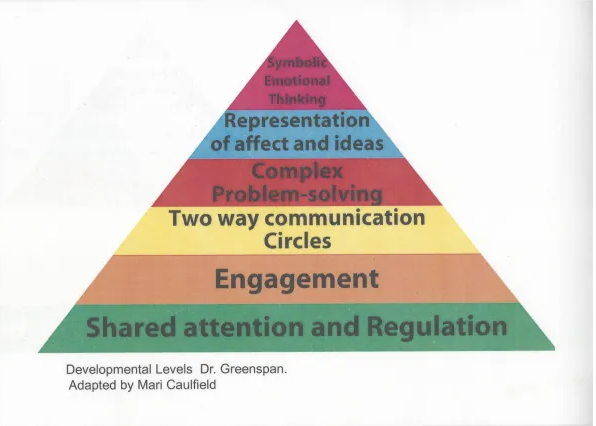
Children develop through a series of Functional Emotional Developmental Capacities, which build the foundation for social, emotional, and cognitive growth. These range from early regulation and engagement to complex thinking and reflective skills into adulthood.
There are nine (9) essential Developmental Capacities in building the foundation every child needs for optimal emotional-social growth and development. These nine levels outline vital developmental domains, even identifying the last three domains work from adolescence to adulthood. How amazing is that?!
- Regulation and interest in the world (0 – 3months)
- Engaging and relating – often referred to as ‘falling in love’, think cooing baby (2 – 5 months)
- Intentionality and two-way communication (2 – 10 months)
- Complex communication and shared problem solving (10 – 18months)
- Using symbols and creating emotional ideas (18 – 30 months)
- Logical thinking and building bridges between ideas (30 – 48 months)
- Multiple perspectives (4 – 7 years)
- Grey area thinking (6 – 10 years)
- Reflective thinking and internal standard of self (10 years to adulthood)
During our parent coaching sessions we often reference DIR/Floortime through this visual representation. We hope this looks familiar!
Individual Differences (I)
Every child processes and responds to the world differently. This includes sensory processing, movement, communication, and problem-solving. Understanding these differences helps tailor therapy to each child—and can also support parents in reflecting on their own preferences and interactions.
Relationships-Based (R)
Strong, responsive relationships are essential for learning. Through connection, co-regulation, and shared interactions, children build the skills needed for development. Therapists support families to strengthen these interactions in everyday life.
Key DIR Strategies
Affect
Using facial expressions, tone of voice, and body language to engage a child emotionally supports connection, regulation, and learning.
Co-regulation
By tuning into and responding to a child’s emotional state, caregivers help them feel supported and regulated. This might mean matching their energy or gently guiding them back to a calm state.
Two-way Communication
Back-and-forth interactions — both verbal and non-verbal — help children understand the impact of their communication and build foundational social and language skills.
Using Floortime at Home
Floortime is a play-based approach that encourages connection, communication, and emotional development. Through playfulness, Floortime allows the fundamental connection in addressing and co-working on the DIR areas of development for each client. Some simple strategies include:
- Set aside uninterrupted time (10–30 minutes) once a day with your child
- Follow your child’s lead and join their play
- Expand play by introducing emotions and new ideas
- Turn actions into shared interactions
- Be kind to yourself—this is a learning process for both you and your child
How Explore and Soar Can Help
We integrate DIR/Floortime principles into all our sessions, creating fun, engaging, and meaningful therapy experiences. We also prioritise parent coaching, empowering families to confidently apply these strategies at home.
If you’d like to learn more or incorporate these approaches into your sessions, we encourage you to speak with your therapist or contact our team.
As Stanley Greenspan said, “Let’s help our children become the poets of their inner lives.”
Until next time,
Sophie
If you’d like to chat more, please don’t hesitate to contact us today! Call us on 0477 708 217 or email admin@exploreandsoar.com.au
PUBLISHED APRIL 2026





Leave a Reply